
Case Study
How Ultrahuman Added Respiratory Intelligence to Its Sleep Ecosystem in Two Weeks
A frictionless SDK integration that became one of Ultrahuman’s best-performing features
About Ultrahuman
Ultrahuman is a global health technology company whose flagship product, the Ring AIR, tracks heart rate variability (HRV), resting heart rate, sleep, recovery, movement, and metabolic health for more than 500,000 users worldwide. Lightweight and worn around the clock, it’s built to give people a science-backed picture of what’s happening inside their bodies to help them act on it.
Central to Ultrahuman’s product model is the PowerPlug: a suite of modular, opt-in features that let users layer additional capabilities on top of the Ring AIR’s core tracking. As the platform has grown, so has the ambition. So, when the team identified respiratory health as a gap in their sleep intelligence offering, they went looking for the best technology available to fill it.
The Challenge: Comprehensive Biometrics, but No Window into Respiratory Health
Ring AIR tracks HRV, resting heart rate, movement patterns, and sleep fragmentation, giving users a detailed picture of what’s happening inside their bodies at night. What it couldn’t capture was sound: the snoring, coughing, and breathing disruptions that shape sleep quality in ways biometrics alone can’t show.
Ultrahuman knew its users deserved to understand this dimension of their health. But, building a best-in-class audio classification system that’s capable of distinguishing snoring from coughing from ambient noise was a fundamentally different challenge from building precision hardware. It would mean years of data collection, model training, and clinical validation. Ultrahuman needed a partner who had already done that work.
The Solution: From SDK handoff to Respiratory Health PowerPlug in two weeks
Sleep Cycle has spent over a decade doing exactly that. With more than three billion analysed sleep sessions, Sleep Cycle’s proprietary AI sound technology is the most validated consumer sleep audio platform in the world. Instead of simply detecting sound, it classifies respiratory events in context, distinguishing snoring from coughing, correlating disturbances with sleep stages, and surfacing the patterns that matter to users.
Integrating that capability into Ring AIR’s ecosystem required a clean, lightweight SDK that could run on a user’s smartphone, process audio entirely on-device without any recordings ever leaving it, and surface results that felt native to Ultrahuman’s morning report experience.
The Sleep SDK delivered all of this, which Ultrahuman’s engineering team integrated in just two weeks. From initial SDK handoff to launch, the timeline was shorter than many teams spend scoping a project. Ultrahuman later described it as the easiest integration they had ever undertaken.
What the Respiratory Health PowerPlug Delivers
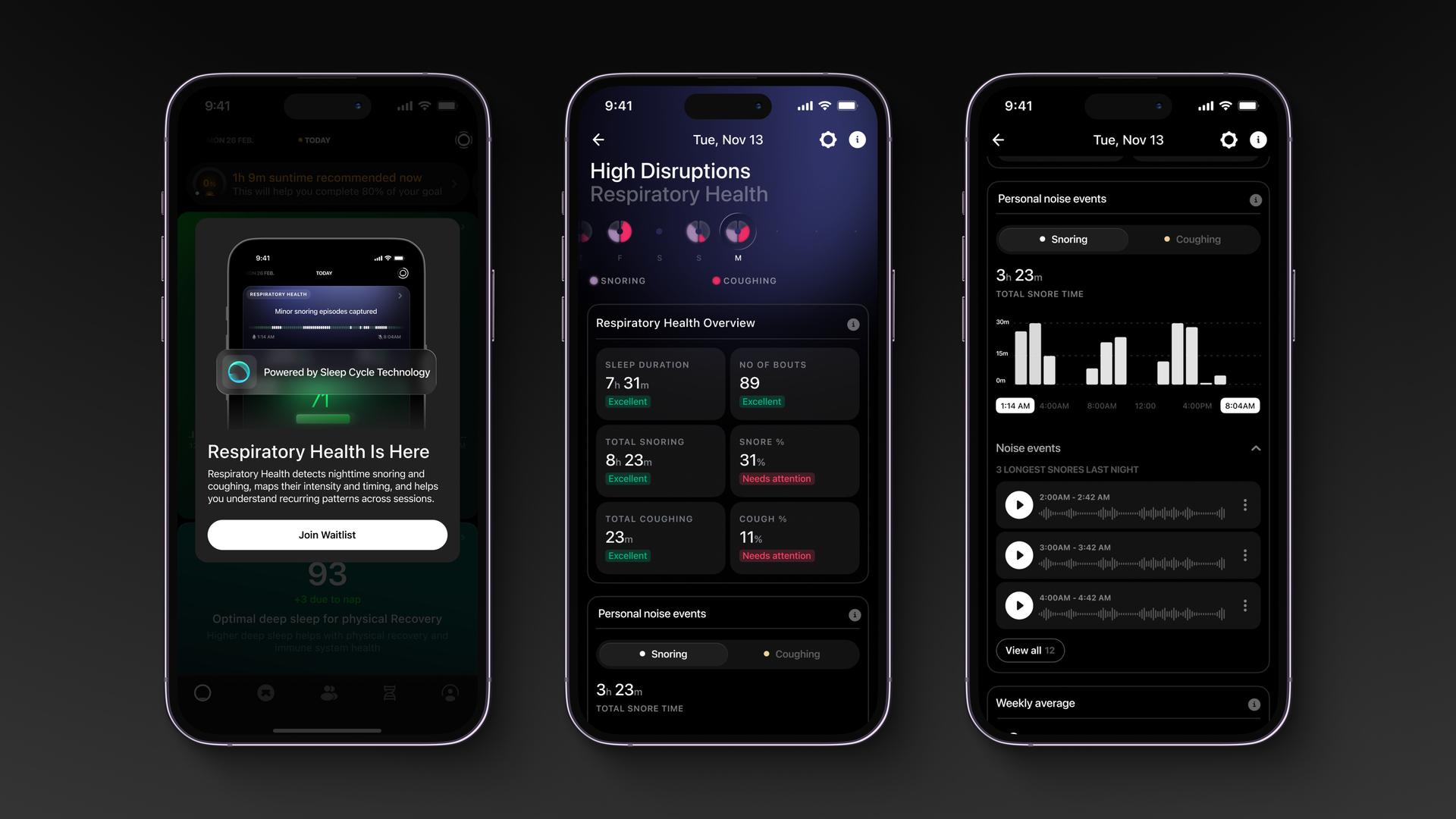
The result was the Respiratory Health PowerPlug, a new capability that fuses Sleep Cycle’s on-device audio classification with Ring AIR’s biometric stream. For Ring AIR users, it meant something their ring had never offered before:
- Snoring, coughing, and breathing disturbances detected through on-device audio classification using the user’s smartphone.
- Every respiratory event mapped against Ring AIR’s biometric data—HRV, resting heart rate, movement patterns, and sleep fragmentation—to show how breathing issues shape sleep quality and recovery.
- A clear morning report showing whether the user snored and what it meant for their recovery, HRV, and health trends over time.
Sleep Cycle’s SDK is built for on-device audio processing, meaning no sound data passes through Sleep Cycle’s servers at any point in the analysis pipeline. Ultrahuman has stated that recordings remain on the user’s device and can be deleted at any time, making privacy a deliberate design choice rather than an afterthought.
The Results: Strong Early Adoption and a Stronger Sleep Intelligence Offering
The Respiratory Health PowerPlug launched in December 2025 to Ultrahuman’s 500,000+ Ring AIR users worldwide. The response was immediate: it quickly became one of Ultrahuman’s best-performing PowerPlugs. This is a strong early signal that respiratory health was a capability users had been waiting for.
The feature has since strengthened Ultrahuman’s position as a sleep intelligence leader, adding a dimension of insight that no other smart ring was offering at the time of launch. For users, the impact is tangible: respiratory data that was previously invisible is now part of the full picture of their nightly health, enabling behavior-driven adjustments like sleeping position, alcohol intake, congestion management, and, where patterns suggest something more serious, better-informed conversations with healthcare professionals.
“Snoring is treated like a joke in popular culture, but physiologically, it’s one of the earliest warning signs that something isn’t right. Most people never see their own snoring patterns, which is why problems escalate silently for years. By pairing respiratory sound analysis with real-time biometrics, Ring AIR now shows users the signals they routinely miss—the breathing disruptions that fragment sleep, impair recovery, and are linked to long-term cardiovascular risk. Awareness is the first line of prevention, and this feature delivers it with unprecedented clarity.”
— Mohit Kumar, CEO, Ultrahuman
Key Takeaways
1. A two-week integration is possible when the SDK is built for it
Ultrahuman described the Sleep SDK as the easiest integration they had ever undertaken. When an SDK is lightweight, well-documented, and designed to fit inside an existing product rather than reshape it, the engineering work that typically delays health tech partnerships simply doesn’t arise.
2. Ring biometrics and respiratory audio tell a story neither can tell alone
Mapping snoring and coughing events against HRV, heart rate, and sleep fragmentation creates a layer of insight that neither dataset offers independently, and that depth drives sustained user engagement.
3. Privacy-by-design is a product decision, not a compliance checkbox
Processing all audio on-device wasn’t a regulatory formality, it was a deliberate choice that shaped user trust from the outset, and one that partners inherit by default when they integrate the Sleep SDK.

Ready to Extend Your Product with Sleep Intelligence?
From sleep tracking to respiratory insights, our SDK helps health technology companies launch new features in weeks, not years.