


Sleep score Pillar
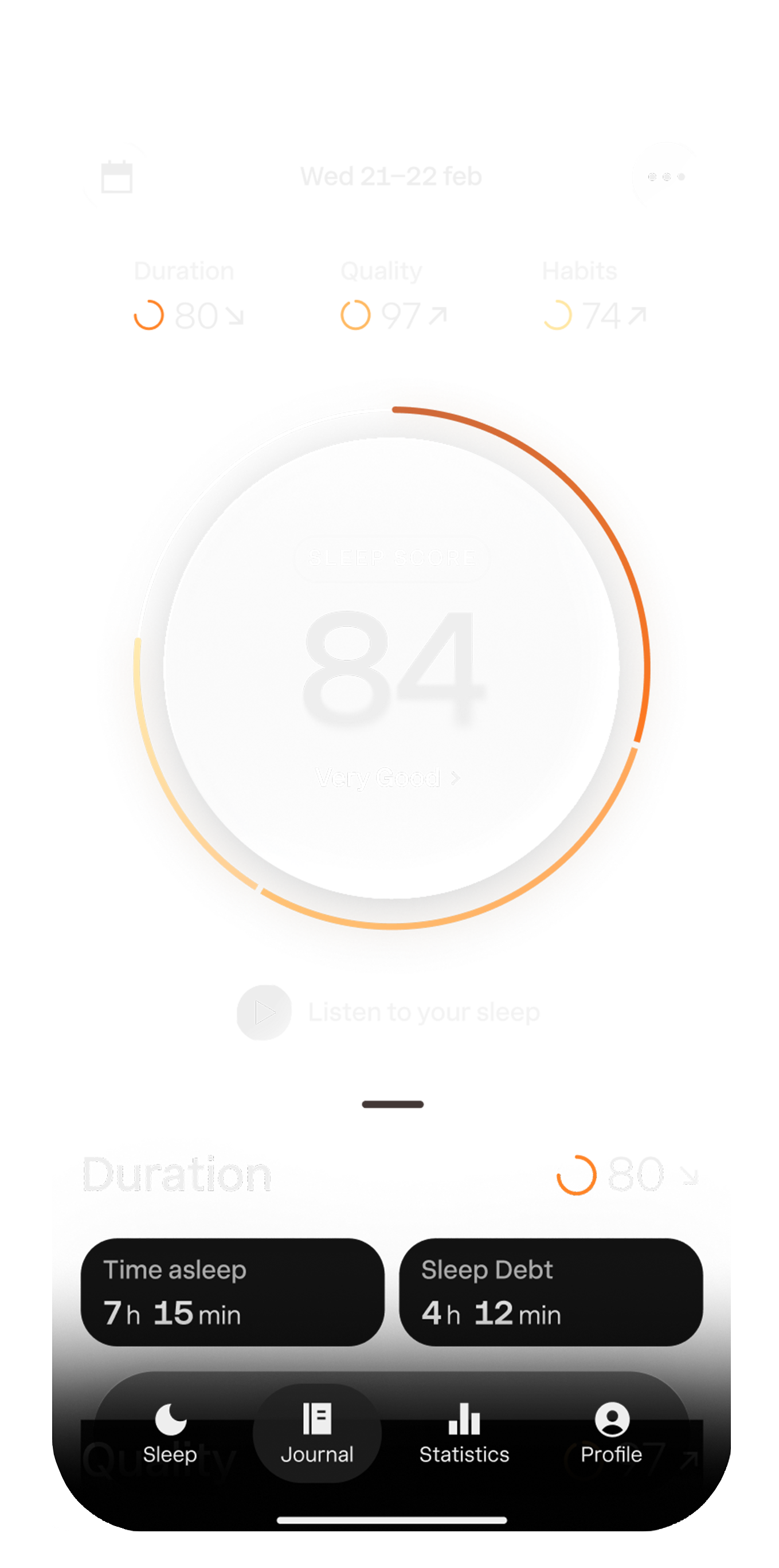
1/3Sleep Duration. Getting enough sleep restores your energy, focus, and mood.
Sleep debt builds up over time, so consistency matters more than catching up.





Ready to see what your body's been trying to tell you?
Recent research found something surprising: sleep regularity is a stronger
predictor of longevity than sleep duration. Those with consistent schedules lived longer, even if they slept fewer total hours than irregular sleepers.
This research changed how we think about sleep health. And it's why we built the Sleep Score the way we did.

Routines are the strongest predictor of health, more than duration.

Quality shows how restorative your sleep actually was.

Duration provides the window for the body's and brain's nightly repair.
Duration
Quality
Routine
Sleep score Pillar
1/3Sleep Duration. Getting enough sleep restores your energy, focus, and mood.
Sleep debt builds up over time, so consistency matters more than catching up.

How long you slept. Too little leaves you tired, too much can mean broken sleep. Most adults need 7–9 hours for a full reset.

Hours of lost sleep over the past 7 days. Small misses add up, but you can recover after several nights of steady sleep.
Sleep score Pillar
2/3Sleep Quality. Hours matter, but uninterrupted sleep matters more.
When sleep flows smoothly, your brain and body can fully recover, helping you wake up rested instead of drained.

Your night cycles through light, deep, and dream sleep. Deep repairs the body. Dream supports memory and emotions. This is sometimes described as sleep architecture.

How long it takes to fall asleep. Ten to twenty minutes is healthy. Very fast or very slow can signal imbalance. The scientific term is Sleep Onset Latency.

How much of your time in bed you actually sleep. Under 85% means restlessness, near 100% can signal exhaustion.

Minutes awake after first falling asleep. More awakenings reduce the restorative sleep your body needs. The scientific term is Wake After Sleep Onset.
Sleep score Pillar
3/3Sleep Routine. Your body runs on rhythm, not weekdays.
Going to bed and waking up at similar times keeps your internal clock in sync and helps you feel more alert and balanced.

How consistent your sleep schedule is. Regular sleep timing supports your body clock and health, so aim for under an hour of variation. The scientific term is Sleep Regularity Index (SRI).

Sleeping in sync with your natural rhythm improves rest. Morning types and night owls need different schedules.

How much your wake-up time varies day to day. Weekend lie-ins can throw your internal clock out of sync. Sleeping in for two extra hours is like crossing time zones, a phenomenon called social jetlag.
Sleep Score gives you a clear picture of what's working in your sleep routine and where small changes might make a meaningful difference in your overall health and how you feel each day.

Duration, Quality, and Routine are consistently linked to better well-being and long-term health.
Here's what makes our scoring different: these pillars don't carry equal weight all the time. They shift based on what your body needs most.
 12
12Remember that one bad night doesn't define your sleep health. Life happens. Stress, travel, a late dinner, a sick kid. Don't worry about a low score after a rough night. Trust the trend, stay consistent, and your body will do the rest.
With over 1 million nightly active users, Sleep Cycle combines science and technology to help you get the sleep you need to feel your best.
Better rest starts with understanding. Sleep Cycle helps you learn what affects your rest to build habits that fuel better days.
With sleep tracking, personalized analysis, a smart alarm and more, Sleep Cycle has all the tools you need to improve your well-being through a good night's sleep. Every night, millions trust the app to support their journey toward restful, consistent sleep.
Sleep Cycle uses your phone's microphone and accelerometer to analyze your movements and sounds during sleep. The algorithm is validated against actigraphy and provides reliable trends for sleep duration, quality, and stages over time.
Most adults spend roughly 50–60% in light sleep, 20–25% in deep sleep, and 20–25% in REM. These ranges vary by age and individual. Sleep Cycle helps you see how your own stages compare and how they change over time.