Understanding Your Sleep Score: The Science Behind Better Rest
Published
Recent research has found something surprising: sleep regularity is a stronger predictor of longevity than sleep duration. People with consistent schedules lived longer, even if they slept fewer total hours than irregular sleepers.
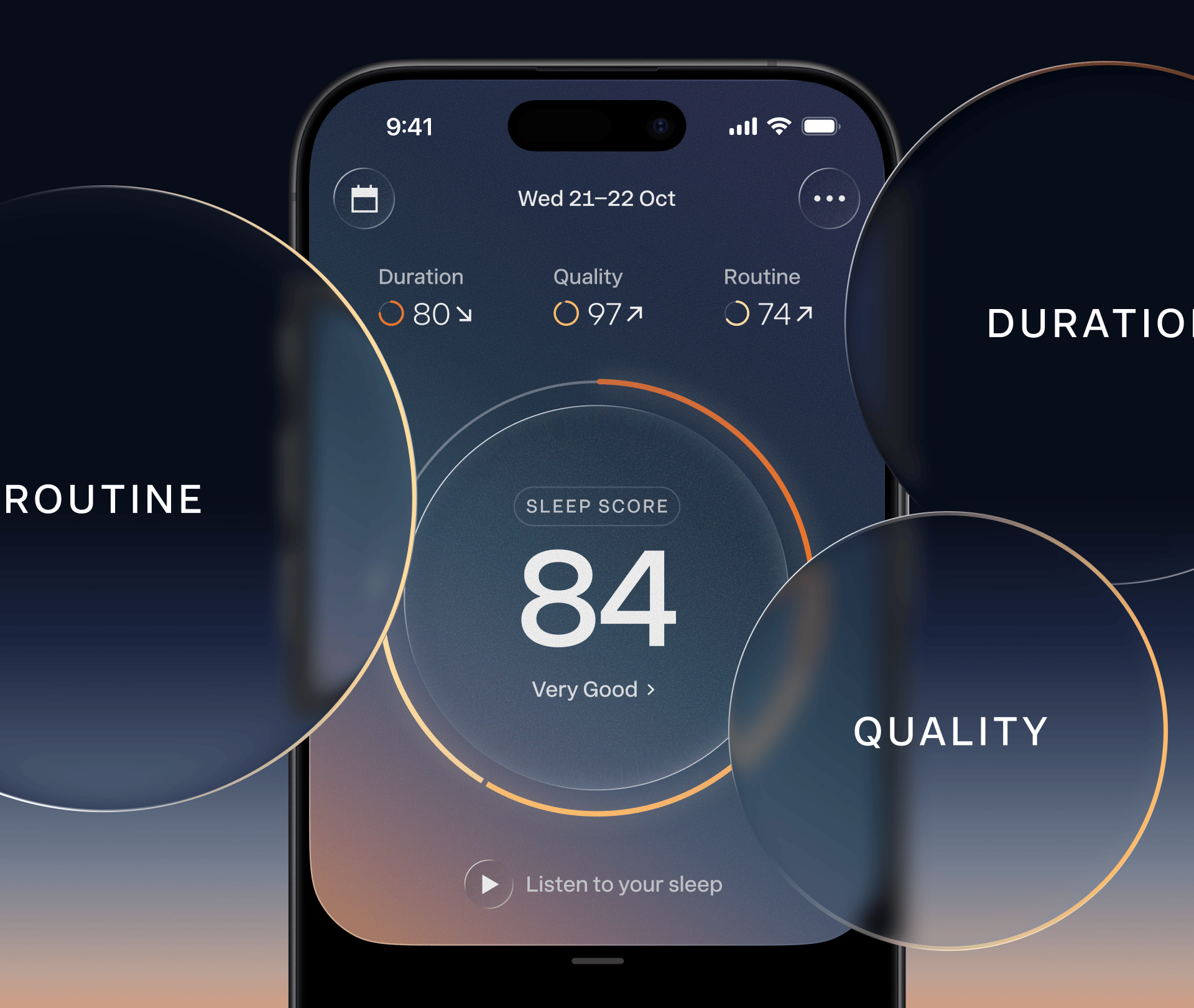
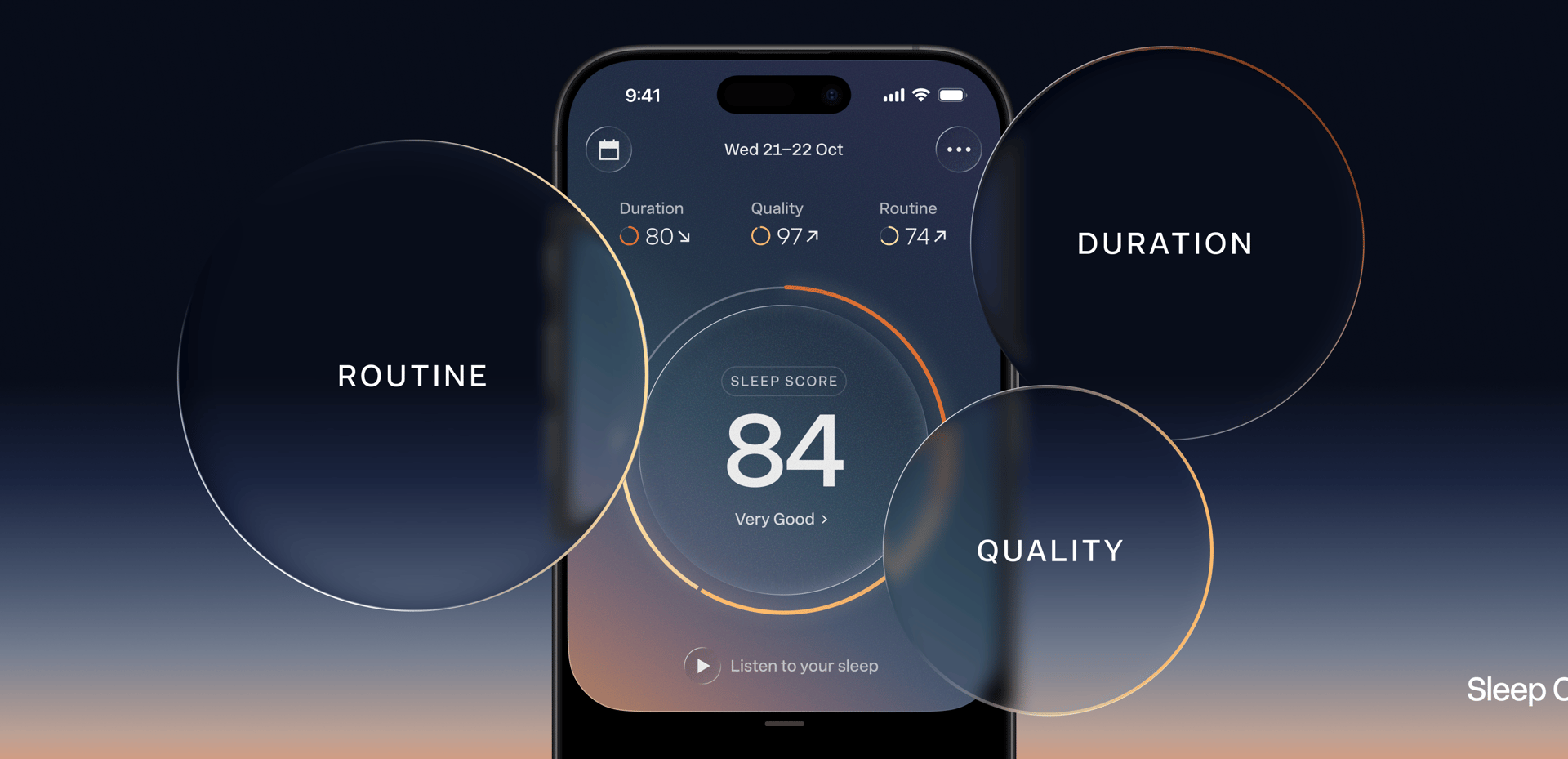
This research changed how we think about sleep health. And it’s why we built our new Sleep Score the way we did. Learn how your Sleep Score is calculated, why it matters, and what you can do to improve it.
How Your Sleep Score Can Help
Your Sleep Score shows how well your sleep supported your body and brain. Sleep is when your body does its most important work, and each stage has an important purpose.
During deep sleep, your brain clears out waste tied to mental decline, your muscles repair, and hormones help your body recover. Dream (REM) sleep processes emotions and strengthens memories, helping you focus and make better decisions the next day. Over time, good sleep supports a healthy metabolism, a stronger immune system, and a longer life.
The Three Pillars of Sleep
Sleep isn’t one thing. It’s a coordinated sequence of biochemical events, circadian cues, neurological switching systems, and recovery processes. The Sleep Score captures three scientifically validated pillars:
- Routine: the alignment of your internal clock.
- Quality: the continuity and depth of your sleep.
- Duration: the physiological time window for recovery.
Use your score to identify patterns, not look for perfection. A dip in one pillar isn’t a failure, it just highlights a behavior to tweak.
Pillar 1: Routine
Your sleep routine has the biggest impact on your Sleep Score and your long-term health. Research shows that consistent sleep/wake timing predicts mortality risk more strongly than total sleep duration, making Routine the foundation of sleep health .
1. Regularity
The Sleep Regularity Index (SRI) measures how likely you are to be asleep or awake at the same time each day.
Your body runs on a 24-hour clock, which is called the suprachiasmatic nucleus. When sleep timing is stable, millions of systems, from hormone release to digestion, sync effortlessly.
To have a good SRI, stick to a stable wake time. It sends a “reset” signal that anchors the entire circadian rhythm.
For example, a 6-hour sleeper with perfect regularity often has better metabolic health than a 9-hour sleeper with widely shifting schedules.
What to Avoid:
- “Catching up” on weekends as this can creates social jetlag.
- Swinging wake times by more than one hour.
2. Social Jetlag
This metric measures how much your wake times differ between weekdays and weekends.
Sleeping in for over two hours on Saturday is biologically similar to flying across time zones. This is called social jetlag.
Aim for wake time variation of less than one hour. For example, if you wake at 7 AM on weekdays and 9:30 AM on weekends, your internal clocks constantly readjust, which reduces your Routine score.
What to Avoid:
- Using weekends to “repay” sleep debt.
- Ignoring the morning light cue that resets circadian rhythm.
Pillar 2: Quality
Quality answers one important question: “What actually happened while I was asleep?”
Spending eight hours in bed doesn’t guarantee restorative sleep. Quality tracks how efficiently and deeply your brain moved through stages and how often it was disrupted.
1. Asleep After (Sleep Onset Latency)
Sleep Onset Latency (SOL) is the time it takes to fall asleep. While this varies from person to person, there are some things that it can indicate:
- 10–20 minutes is ideal.
- Under 5 minutes means severe sleep debt.
- Over 30 minutes can signal circadian misalignment or elevated stress hormones like cortisol or adrenaline.
If you consistently fall asleep instantly, you likely need more total sleep. If it takes too long, adjust your wind-down routine.
For example, someone who takes 45 minutes to fall asleep may be going to bed before their biological “sleep gate” opens.
What to Avoid:
- Going to bed too early “just to be safe”.
2. Interruptions
Interruptions shows your Wake After Sleep Onset (WASO), which is the time spent awake after first falling asleep.
Each wake up can reset your sleep cycle. You’ll need to reenter lighter stages before reaching deep or dream (REM) again. High WASO fragments sleep and reduces brain restoration.
To help reduce WASO, you can try improving your sleep environment with a cool room, blackout curtains and a consistent bedtime routine.
For example, if you wake four times per night, you lose precious deep sleep, even if total sleep seems adequate.
What to Avoid:
- Drinking alcohol before bed.
- Being too warm when you go to sleep.
3. Sleep Stages: Light, Deep, Dream
Your brain cycles through stages every ~90 minutes. They are:
- Light Sleep: The stage between wakefulness and deeper sleep.
- Deep Sleep: The brain’s glymphatic system “power-washes” toxins.
- Dream (REM): Supports emotional regulation, learning, memory consolidation.
These processes only work with continuous, uninterrupted cycles.
To reduce fragmented cycles, prioritize slow, consistent wind-down routines to protect stage continuity.
What to Avoid:
- Obsessing over stage numbers.
4. Sleep Efficiency
Sleep efficiency shows the percentage of time in bed you actually spent asleep.
Below 85% suggests disrupted or inefficient sleep. While important sleep efficiency is important, it’s partially captured by SOL and WASO, so it’s a smaller part of the overall Sleep Score.
To improve your sleep efficiency, shorten time in bed if you toss and turn; extend it if you’re constantly overtired.
What to Avoid:
- Fixating on a single night.
Pillar 3: Duration
Duration gives the opportunity for your sleep architecture to unfold.
1. Time Asleep
Time asleep shows the hours of actual sleep, not time in bed.
During sleep, the brain clears adenosine, the “fatigue chemical” that builds up during the day. Not clearing everything leads to grogginess and slower reaction time the next morning. Aim for 7–9 hours unless otherwise advised.
For example, sleeping 6 hours nightly accumulates residual adenosine, impairing performance even if you “feel okay.”
What to Avoid:
- Believing you’re a “short sleeper” without clinical confirmation.
- Assuming more hours automatically means better sleep.
2. Sleep Debt
Sleep debt is how much cumulative sleep you’ve missed over the past week.
One long night doesn’t erase a week of short ones. Recovery is nonlinear: cognitive alertness improves quickly, but metabolic and emotional systems take days to catch up.
To reduce sleep debt, you can reduce variability. Prioritize your sleep regularity instead of relying on “makeup” sleep.
What to Avoid:
- Believing 10 hours on Saturday offsets five nights of 5 hours.
- Trying to “make up” sleep with irregular hours.
Why Patterns Matter More Than Nights
One bad night doesn’t define your sleep health.
Life happens—stress, travel, late meals, sick kids. Your Sleep Score will dip occasionally. What matters is the 7–14 day trend, which reflects your true biological rhythm and recovery capacity.
Your body is remarkably resilient when you give it consistency.
The Takeaway
- Routine drives your circadian alignment and metabolic health.
- Quality ensures your brain and body get real restoration.
- Duration provides the time window for deep recovery.
- Consistency, not perfection, is the key to better sleep.
Take the next step and start by setting a fixed wake-up time tomorrow—and keep it within a 1-hour window all week. This single change can improve all three pillars of your Sleep Score.
FAQ: How Sleep Works
Why is sleep regularity more important than sleep duration?
Regularity stabilizes circadian rhythms, improving metabolic health, hormonal balance, and long-term mortality risk, even when total hours fluctuate. Large cohort studies show sleep regularity is a stronger predictor of health outcomes than duration alone.
What’s the ideal amount of deep sleep?
There’s no universal “perfect” number. Deep sleep naturally decreases with age and varies from person to person. What matters most is protecting continuous sleep cycles, which allow deep sleep to occur naturally.
Can I fix sleep debt by sleeping in?
Not reliably. Cognitive symptoms may improve, but metabolic and hormonal systems recover slowly. Multiple consistent nights of adequate sleep are required to repay real physiological sleep debt.
Why do I feel groggy even after 8 hours?
You may have high WASO, poor sleep efficiency, or misaligned sleep timing. Residual adenosine or waking from Deep Sleep can also cause morning grogginess.
Is it bad to fall asleep instantly?
If you fall asleep in under 5 minutes consistently, it’s a sign of significant sleep debt, not “being a good sleeper” .